

Harry Kane has won the 2026 men’s Ballon d’Or, becoming the first Englishman to claim the award for 25 years. At the London Palladium on Monday 26 October, the Bayern Munich striker finished ahead of Kylian Mbappé and Lamine Yamal to receive football’s most celebrated individual prize.
For a player whose career has so often been discussed through what he had yet to win, this is an achievement with particular weight. His case rested on an exceptional season for club and country, with goals on an extraordinary scale and domestic trophies at Bayern. The award recognises the player Kane became through years of refinement, rather than one sudden breakthrough.
The season that made Kane the winner
England’s official account credits Kane with 73 goals in 65 appearances across the 2025/26 season for club and country. Of those, 61 came for Bayern and 12 for England. He helped his club win the Bundesliga, DFB-Pokal and German Supercup, while England finished third at the World Cup.
New customer offers · Advertising


Side Action may earn a commission. Compare betting sites · BeGambleAware.org · GAMSTOP
The distinction between the two totals matters. Kane did not score 73 goals for Bayern alone, and the award concerned the completed season rather than his opening months of the current campaign. Even with those boundaries clear, the record is remarkable.
Our view is that the breadth of the contribution strengthens the headline number. A prolific club season can establish a candidate; maintaining a scoring contribution through international football gives voters another set of performances to assess. Kane offered a substantial body of evidence across both settings.
Big goals gave the numbers their meaning
Bayern’s statistical review records 61 goals in 51 competitive club appearances. Among them were 14 in the Champions League and 10 in the German Cup. In the cup final against Stuttgart, he scored all three goals in Bayern’s 3–0 victory.
Those details help explain the season more effectively than an isolated total. A goal that settles a final has a different place in a campaign’s story from another strike in a comfortable league win. Kane supplied both the volume associated with an elite scorer and memorable contributions attached to silverware.
He also scored in six consecutive Champions League knockout matches, according to Bayern, equalling a sequence achieved by Cristiano Ronaldo. That European record matters to the argument. His influence extended into the rounds where opponents have fewer weaknesses and the consequences of a missed opportunity become greater.
More than the best goalscorer
Kane also collected the Gerd Müller Trophy, the award recognising the leading goalscorer for club and country. Winning that prize alongside the Ballon d’Or underlines the distinction between two judgements: who scored the most and who voters considered the outstanding player.
The wider case for a centre-forward includes what he makes possible for others. Receiving under pressure, drawing a defender away from goal and releasing a runner can shape an attack before the final touch. These contributions are harder to capture in the award-night headline, but they are useful things to watch when assessing Kane’s football.
That is why describing him only as a finisher feels incomplete. Our reading of his appeal is that the scoring comes with the ability to participate in constructing attacks. A striker who can connect play as well as end it gives team-mates several ways to use him.
Harry Kane in Bayern Munich colours. Archive photograph published during the 2026 Ballon d’Or build-up.
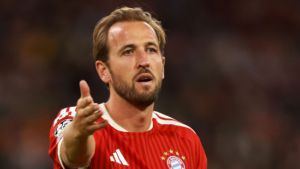

Harry Kane in Bayern Munich colours. Archive photograph published during the 2026 Ballon d’Or build-up.
Why the award matters to England and Bayern
Kane becomes the fifth Englishman to win the men’s Ballon d’Or, following Stanley Matthews, Bobby Charlton, Kevin Keegan and Michael Owen. Owen’s 2001 victory had been the most recent. The gap makes this a notable moment for English football without requiring a claim that Kane’s success settles every argument about the country’s greatest player.
For Bayern, he is the first winner since Karl-Heinz Rummenigge in 1981. The club’s roll of honour also includes Gerd Müller and Franz Beckenbauer. Kane now appears alongside names that shaped its history.
These comparisons establish the company he has joined, rather than providing a precise ranking across generations. Different players faced different competitions and expectations. The useful conclusion is narrower and strong enough: Kane has earned a distinction that very few English or Bayern players have received.
Mbappé and Yamal made this a serious contest
UEFA lists Mbappé second and Yamal third in the final men’s standings. Michael Olise, Kane’s Bayern team-mate, finished ninth. The result placed Kane ahead of opponents with very different styles, which is part of what makes the Ballon d’Or such a persistent source of debate.
There is no single statistic that fairly compares every role. Voters must decide how to weigh scoring against creation, individual influence against team achievement and sustained performance against the most memorable matches. Reasonable supporters can disagree about those judgements without denying the winner’s quality.
Kane’s strength was the clarity of his case. His scoring record was exceptional, his team won domestic honours and his European output gave the argument further substance. It is a convincing explanation for the outcome without pretending that the result was inevitable or that the other contenders lacked strong seasons.
What comes next for the Ballon d’Or winner
At the ceremony, Kane described the campaign as the best season of his career. His thanks to team-mates, coaches and family also acknowledged the support behind an individual honour. The photograph will centre on him, but producing chances and sustaining a team over a season are shared tasks.
The award now changes the description attached to his name. Every difficult spell will come with the expectations placed on a Ballon d’Or winner, while opponents will have another reason to measure themselves against him. Maintaining that level is a fresh sporting challenge.
For supporters, the next question is how he builds on the achievement. More major team success would add another dimension to the story. It would not make this award more valid; it would give the next chapter its own substance.
The Side Action verdict
Kane is a worthy winner because the evidence extends beyond the ceremony’s emotion. The completed season combines exceptional scoring, decisive cup performances and contributions on the European stage. His place in the English and Bayern rolls of honour gives that season a lasting historical reference.
The most interesting part is how familiar many of his qualities already were. The patience, passing and finishing did not arrive with the trophy. The Ballon d’Or gives those qualities their highest individual recognition after a campaign that made them impossible to overlook. Kane has earned his night in London. Now attention returns to what he can do with the ball.
Reporting checked against the original source ↗. Side Action is independent of the source publication.